SAO vs. regular aqueous ozone: what is the difference and why does it matter?
Aqueous ozone technology is gaining attention in Thailand as an alternative to chemical cleaners. But the term "aqueous ozone" covers vastly different technologies, from budget ozone generators costing a few thousand baht to certified Stabilized Aqueous Ozone (SAO) systems backed by international safety certifications.
This article explains the differences clearly so businesses can make an informed decision. New to SAO? Start with our complete guide to Stabilized Aqueous Ozone →
What is regular aqueous ozone?
Regular aqueous ozone is produced by injecting ozone gas (O3) directly into water. Ozone is an oxidizer 3,000 times more powerful than chlorine, so it effectively kills pathogens and breaks down organic matter.
The problem is that ozone in water is inherently unstable. Ozone molecules naturally want to break down back into oxygen (O2). The more minerals in the water, the faster the ozone decomposes. Tap water in Thailand, which contains high mineral content in many areas, causes regular aqueous ozone to break down very quickly, sometimes within just 10-15 minutes.
This means regular aqueous ozone must be produced and used immediately. It cannot be stored for later use.
What is Stabilized Aqueous Ozone (SAO)?
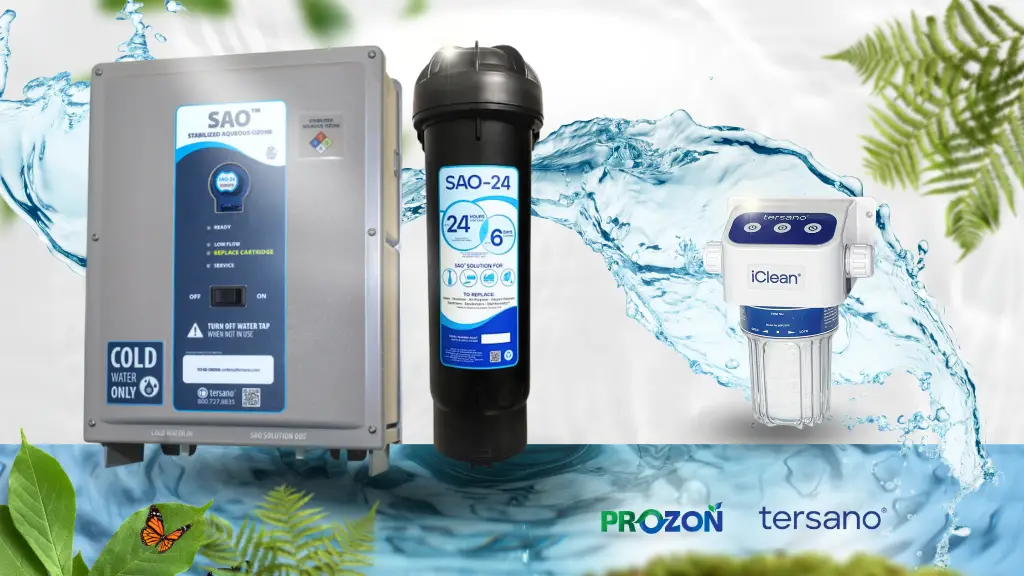
SAO is aqueous ozone that has been stabilized using patented technology from Tersano, Canada. The key component is the SAO-24 cartridge, which removes the minerals that accelerate ozone decomposition from the water before ozone is injected.
The result is aqueous ozone that stays effective for 24 hours, transforming it from "use immediately" to "produce ahead of time." This is a critical difference for real-world business use.
Side-by-side comparison
Stability and shelf life
Regular aqueous ozone breaks down within 15-30 minutes, depending on water quality, temperature, and mineral content. In Thailand's hot climate, this may be even faster. Must be produced and used on the spot.
SAO stays effective for 24 hours. It can be filled into spray bottles and used throughout an entire building. Produce it in the morning, use it all day. Cleaning carts can carry SAO bottles to every floor and every room.
Performance consistency
Regular aqueous ozone performance varies by local water quality. Hard water areas get weaker results. There is no way to verify ozone concentration in each batch.
SAO delivers consistent results every time. The SAO-24 cartridge removes the minerals that cause inconsistency before ozone is introduced. Today's batch performs the same as yesterday's.
Certifications
Regular aqueous ozone has no specific certifications as a cleaning or disinfection agent. Most ozone generators are not tested by food safety or health authorities.
SAO is certified by:
- EPA as a safe disinfectant for public facilities
- NSF as safe for food contact surfaces
- Green Seal as environmentally friendly, free from PFAS and harmful chemicals
These certifications are critical for businesses that need to pass audits, such as HACCP for food factories or Thai FDA inspections for hospitals.
Safety
Regular aqueous ozone Some budget ozone generators may release excess ozone gas into the air, which can irritate the respiratory system in enclosed spaces. No SDS (Safety Data Sheet) documentation.
SAO has an SDS rating of 0-0-0-A, the highest safety level:
- 0 = No health hazard
- 0 = Not flammable
- 0 = No chemical reactivity
- A = No special protective equipment required
Tersano SAO dispensers are engineered to dissolve ozone into water efficiently with no ozone gas leakage into the ambient air.
Patent and technology
Regular aqueous ozone is open technology that anyone can produce. Quality varies enormously between manufacturers. No quality baseline.
SAO is patented Tersano technology backed by over 20 years of research and development. The SAO-24 cartridge is a proprietary innovation that cannot be replicated, ensuring every SAO unit delivers the same quality and performance.
Total cost of ownership (TCO)
Comparing equipment price alone does not tell the full story. You need to consider the total cost over the lifetime of the system.
Regular aqueous ozone
- Lower equipment cost upfront
- Frequent part replacements (short-lived ozone tubes)
- Performance degrades over time
- Still need supplementary chemicals for some tasks (ozone breaks down too fast)
- No usage data or monitoring
- No certifications, may fail audits
SAO (Tersano)
- Higher equipment cost upfront
- SAO-24 cartridge replaced every 12-24 months (supports 3,000 liters)
- Consistent performance throughout cartridge life
- Replaces nearly all chemical products, reducing monthly costs by 80-90%
- lotus PRO v9 includes IoT for real-time usage monitoring
- EPA, NSF, Green Seal certified, passes all standards
Over a 3-5 year period, SAO typically costs less in total because the monthly savings on chemicals accumulate to exceed the equipment cost within 6-12 months.
Which should you choose?
Regular aqueous ozone may be suitable for:
- Personal household use
- Tasks requiring ozone at a single point of use, used immediately
- Very limited budgets with no certification requirements
SAO is the right choice for:
- Businesses that clean and disinfect daily
- Businesses that must pass HACCP, GMP, ISO, or Thai FDA audits
- Hotels, hospitals, food factories seeking to reduce chemical costs
- Businesses that prioritize employee safety
- Organizations with sustainability and ESG commitments
Summary
Both regular aqueous ozone and SAO use the same principle of ozone dissolved in water. But SAO overcomes the fundamental limitations of regular aqueous ozone through the SAO-24 cartridge, which ensures stability for 24 hours, consistent performance, and international certifications that businesses need.
For businesses in Thailand evaluating ozone water technology, consider carefully whether basic aqueous ozone meets your needs, or whether you need SAO with its stability, certifications, and proven reliability.
Learn more about Tersano SAO technology, compare all SAO products, or contact Prozon for a free consultation.