Your Water Filter Could Be Doing More Harm Than Good
Steve Hengsperger, CEO of Tersano, has shared a striking insight that challenges everything the foodservice and hospitality industries think they know about water safety. The carbon filters and reverse osmosis systems that hotels, restaurants, and commercial kitchens trust to deliver clean water may actually be creating the conditions for serious contamination.
Here is the problem most water filter manufacturers will not tell you: when a carbon filter removes chlorine from your water supply, it eliminates the only chemical barrier that was holding waterborne pathogens in check. What replaces it? Nothing. And into that vacuum, bacteria move in fast.
The result is that your beverage dispensers, ice machines, soda fountains, and coffee systems can quietly become high-speed incubators for Pseudomonas, Legionella, E. coli, and coliform bacteria — while looking completely normal from the outside.
A study of commercial restaurant soda fountain systems found that nearly 50% of samples tested positive for coliform bacteria. Not in poorly maintained kitchens. In ordinary commercial operations, with ordinary water filters in place.
Why Traditional Cleaning Does Not Solve This
The root of the problem is biofilm — and it is more resilient than most facilities realise.
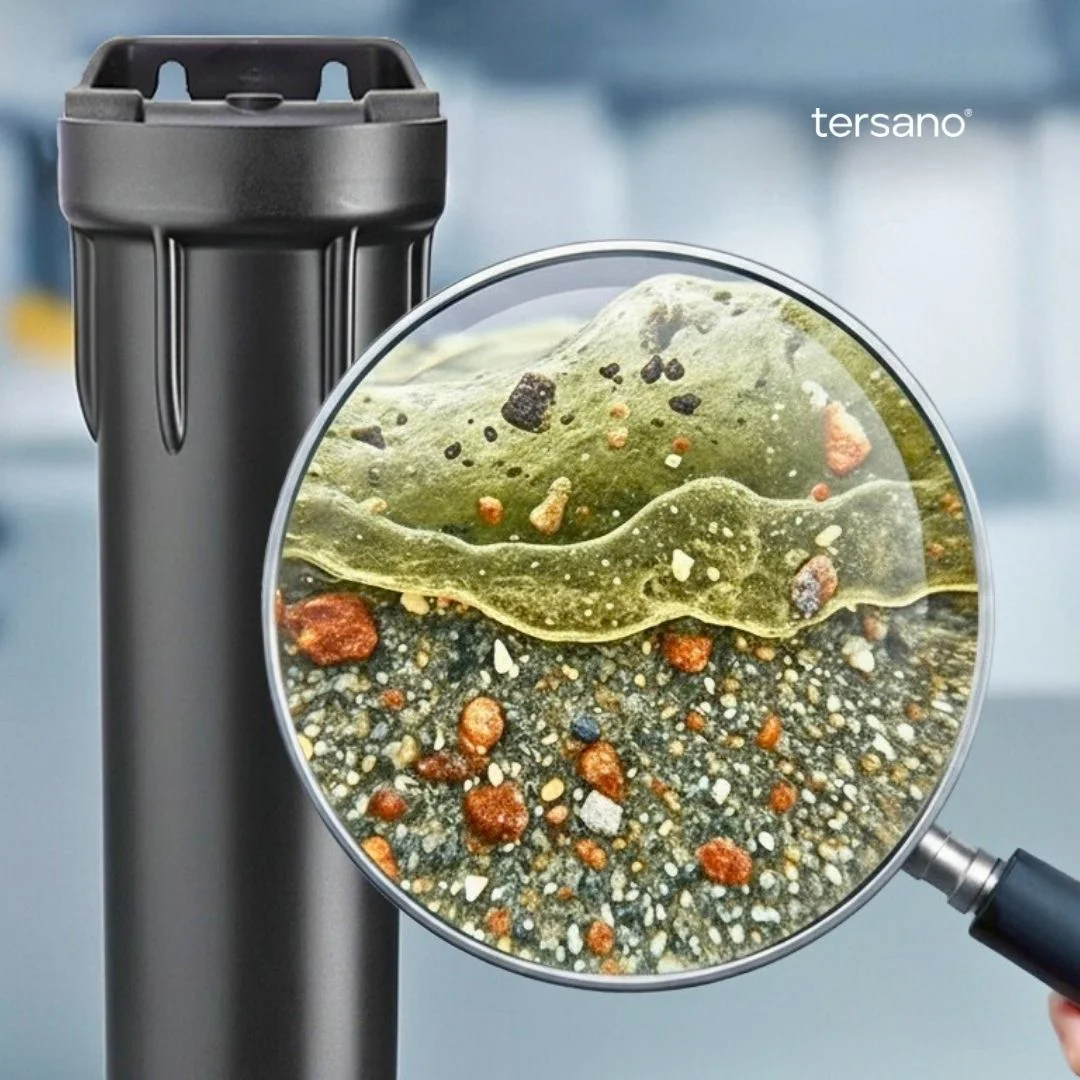
Biofilm is not just surface contamination. It is a structured community of microorganisms that attach to the inner walls of pipes, water lines, and equipment and form a self-protective matrix. This matrix is biologically engineered to resist chemicals, survive cleaning cycles, and regenerate after physical removal. Standard cleaning protocols — including scheduled deep cleans — only remove the surface layer. The colony underneath remains, grows back, and spreads.
Four facts about biofilm that every hotel and F&B operator in Thailand needs to understand:
95% of bacteria in your water system live in biofilm, not in the water. Standard filters only treat the water passing through them. The pipe walls, distribution lines, and equipment chambers — where the real bacterial load lives — are left completely untreated.
Biofilm survives freezing. Ice machines are not a safe zone. Biofilm not only survives in ice-making equipment — it thrives there. The freeze-thaw cycle does not kill it. It protects it.
A saturated carbon filter becomes food, not protection. Once a carbon filter reaches the end of its useful life, it stops being a barrier and becomes a nutrient-rich surface for bacterial growth. The filter itself becomes the contamination source. Most filters are changed on a schedule — not based on actual saturation. The gap between those two things is where pathogens take hold.
Standard filters make no claims about pathogen protection. Read the fine print on any carbon block filter. The certifications cover taste, odour, and sediment. They do not claim to protect against biofilm, Pseudomonas, Legionella, or coliforms in water lines. The filter is doing exactly what it was designed to do — just not what most operators assume it does.
For hotels, restaurants, and commercial F&B facilities in Thailand, the stakes are high. A single waterborne illness outbreak linked to a commercial facility can cost more than USD $2.1 million in liability, brand damage, and operational disruption — and that figure does not account for the human cost.
HACCP compliance requires identifying and controlling biological hazards in food-contact water. Biofilm in water lines is a biological hazard. Standard carbon filtration does not control it.
Time to Rethink Water Filtration
The water treatment industry has operated on the same passive filtration logic for decades: put a filter in the line, change it on schedule, and assume the water is safe. That assumption has never been more exposed than it is today.
What the industry actually needs is a system that does not just filter water as it passes through — but actively treats the lines themselves, continuously, without adding chemicals or requiring manual intervention.
That system now exists, and Prozon is bringing it to Thailand.
The lotus® Water Treatment System (WTS) uses patented AMP Technology (Active Microbial Protection) — a dual-function approach that combines standard water filtration with continuous active line treatment. As water flows through the system, AMP Technology generates a safe, low-level oxidising agent from water and oxygen. That agent travels through your water distribution lines and destroys existing biofilm while preventing new biofilm formation — 24 hours a day, 7 days a week, without chemicals, without residue, and without manual cleaning cycles.
When the treatment process is complete, the active agent reverts to water and oxygen. Nothing harmful is added to your water. Nothing toxic is left behind.
The lotus® WTS is EPA registered, NSF certified, and Green Seal approved. It is compatible with HACCP food safety standards and supports LEED and WELL building certification requirements. It is the only commercial water treatment system available in Thailand that addresses the full picture of water safety — not just what comes out of the tap, but what lives in the lines that deliver it.
For hotels, the system protects ice machines, water dispensers, and beverage systems — the exact equipment where biofilm contamination is most common and most invisible. For restaurants and commercial kitchens, it delivers HACCP-compatible water line protection without chemical inputs. For F&B operators across Thailand, it closes the gap that every carbon filter in the country leaves open.
Prozon is now accepting early access registrations for the lotus® WTS launch in Thailand. If you manage water quality for a hotel, hospital, restaurant group, or commercial facility, this is the system your current filter cannot replace.
Register for early access to lotus® WTS →
Want to understand the full technology behind AMP? Learn how lotus® WTS works →
See the visual proof: The Proof Is in the Pipes — what treated vs. untreated water lines actually look like →