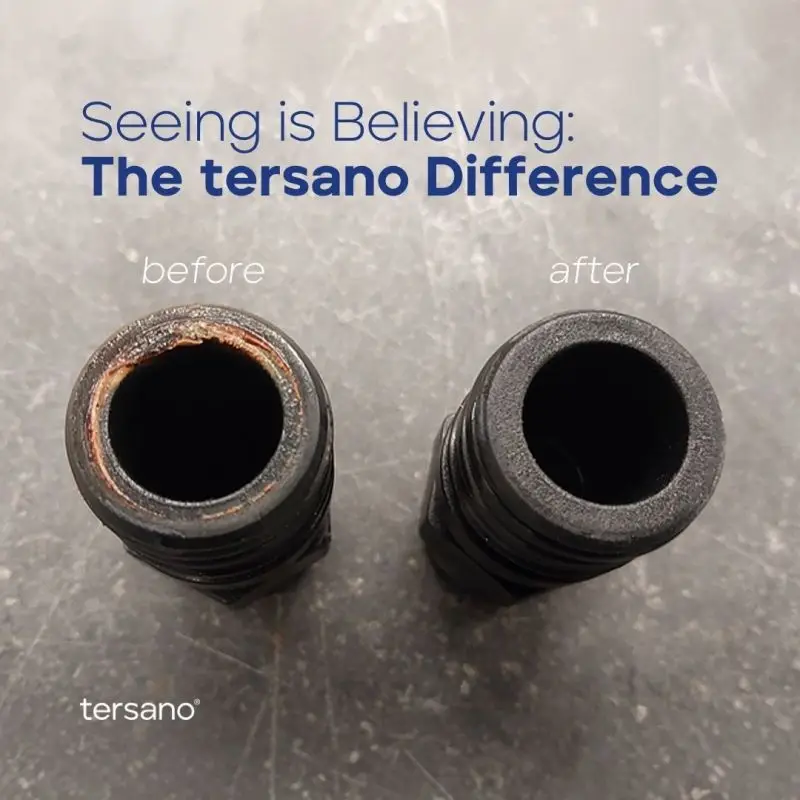
 Photo: © Tersano Inc.
Think Your Ice Machine Is Clean? The Bacteria Inside Think Otherwise.
There is a version of water safety that most hotels and restaurants operate under: the filter is in place, the maintenance schedule is followed, the water coming out of the tap looks clear. Clean means safe.
That assumption does not survive contact with a microscope.
Tersano recently shared a side-by-side comparison of two water line plugs — one from an untreated inflow, one from an outflow treated by the lotus® Water Treatment System. The difference is visible to the naked eye. One plug is coated in the brown-grey slime of biofilm and bacterial buildup that comes with standard municipal water. The other is clear.
That image is not a dramatic exception. It is a routine result. And it raises an uncomfortable question for every hotel and F&B operator in Thailand: if this is what untreated water lines look like, what is growing inside your ice machine?
The Ice Machine Is Not a Safe Zone
Ice is the one component in your beverage system that guests consume without it ever going through a final heat process. It goes directly into a drink, directly to a table, directly to a guest.
And yet ice machines are among the most contaminated pieces of equipment in commercial F&B environments — not because of poor hygiene, but because of the way the water that supplies them is treated.
Traditional carbon filters remove chlorine from your water supply. Chlorine is the only chemical barrier preventing waterborne pathogens from colonising your distribution lines. Remove it, and you remove the barrier. Into that gap, biofilm moves in fast.
Biofilm does not just survive in ice-making equipment — it thrives in the freeze-thaw cycle. 95% of bacteria in water systems live in biofilm, not in the water itself. Standard filters treat the water passing through them. The walls of your ice machine water lines, the internal chambers, the distribution points — these are left completely untreated.
Once a carbon filter reaches saturation, the problem compounds. The filter stops being a barrier and becomes a nutrient-rich surface for bacterial colonies. E. coli, Pseudomonas, Legionella, and coliform bacteria do not announce themselves. They build up quietly, in the lines, behind the panel, in the equipment your guests trust the most.
The bacteria in your ice machine are not a maintenance problem. They are a filtration architecture problem.
From the Warehouse to the World's Largest QSR
Proof of concept is one thing. Proof at scale is another.
lotus® Water Treatment System units recently left the warehouse for installation at one of the world's most recognised quick-service restaurant brands — a global leader known for its precision, consistency, and a menu that billions of people reach for every day. The brand cannot be named, but the deployment is real.
Beverage systems across select restaurants are now running on lotus® WTS. Every soda, every iced coffee, every fountain drink — flowing through water lines that are not just filtered, but actively treated around the clock to prevent biofilm formation at the source.
As Tersano put it: "Our conscience is as pure as the water we're filtering."
This is not a regional trial. It is the beginning of a new operational standard for water safety in commercial foodservice — and it is now available in Thailand.
What lotus® WTS Actually Does
The lotus® Water Treatment System uses AMP Technology (Active Microbial Protection) — a dual-function approach that combines standard filtration with continuous active line treatment.
As water flows through the system, AMP Technology generates a safe, low-level oxidising agent from water and oxygen. That agent travels through your entire water distribution system — destroying existing biofilm, preventing new formation, and leaving nothing harmful behind. When the process is complete, it reverts to water and oxygen.
The result is exactly what Tersano's pipeline comparison shows: clean outflow from lines that would otherwise carry the standard bacterial load of untreated municipal water. Visibly. Measurably. Continuously.
EPA registered. NSF certified. Green Seal approved. HACCP compatible. No chemicals. No manual cleaning cycles. No residue.
Prozon is now accepting early access registrations for lotus® WTS in Thailand. Hotels, hospitals, restaurant groups, and commercial facilities — this is the system your current filter was never designed to replace.
Register for early access to lotus® WTS →
Want to understand why carbon filters create the problem in the first place? Read: Your water filter may be the biggest biohazard in your building →
Source: Tersano — lotus® WTS installation and pipeline comparison